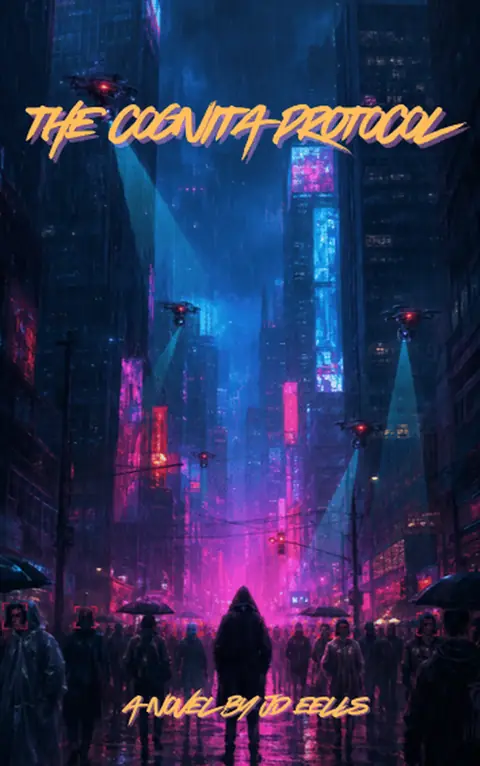
Ren Vale crouched behind a collapsed cargo drone, two gloved fingers against the wet concrete. Every four seconds the bunker’s perimeter array swept the alley. Curb sensors stopped transmitting; three seconds later they resumed. On the third interval, he moved. His contact had called the bunker abandoned. Someone was still paying for the sweep.
At the service seam, his fingertip probe found little heat and no radio traffic. But current pulsed through the shielding at precise intervals. Something inside was still running.
“Welcome back,” Pith said through the bone relay. His ceramic core rode inside Ren’s shielded coat pocket. His full designation was PITH-09: Pattern Integration and Tactical Heuristics, unit 09. Pith for short. He was an independent artificial intelligence, capable of learning, reasoning, and refusing an instruction. Possession of him could cost Ren every identity he had.
“Route channel three,” Ren murmured.
Pith shifted onto a prearranged narrowband tone. “Nothing outside is connected. Open the conduit and use the wired maintenance line. Your old credential still works on the local reader.”
“You could have led with that.”
Ren opened the conduit with a magnetized pry loop. Behind it ran a one-way optical line, a wired maintenance connection, and a tamper filament thin enough to vanish against his glove. He kept the filament intact and connected a stolen service controller to the maintenance line. Once it accepted the controller, he ran an isolated cable to the jack behind his right ear.
His interface displayed the bunker’s internal layout. Separate power systems, mechanical locks, and one-way data paths stood between him and the storage. Opening one would not open the others.
“Read only,” he said. “Watch the power use and compare the system clocks.”
Four separate defense systems appeared. A fifth access point offered to accept his obsolete credential. Its login routine would record his neural signature and send an alert. Ren kept his thumb on the cutoff.
“Leave that one,” he said.
Ren delayed the service controller with a fault pulse, then returned the bunker’s own diagnostic challenge through the maintenance loop. One defense recorded a self-test. Another recorded an admitted technician. He moved only after Pith confirmed that both incompatible entries had committed to the audit logs.
He checked current draw and heat at the wall while Pith compared the logs. The write bridge had no radio; the relay held no storage. His thumb connected them only for the pulse, then broke the path.
Thirty-one minutes later, the backup routine released a sealed ten-gigabyte copy. Ren checked it against three independent verification codes. No alarm had been triggered. He disconnected the slate.
His maintenance event would remain in the audit chain. Before disconnecting, he recorded the same fault signature against six Kaspar controllers scheduled for replacement. An investigator would have to separate his work from theirs. He had bought time, not disappearance.
He returned during the afternoon shift change under a refrigeration technician’s identity. At home, the dust on the upper hinge and the varnish across the service plate were intact. He checked the emergency hatch, docked Pith, and set his gear in the sterilization tray. Water hissed against the hot steel.
He sealed the slate in a case keyed to his peripheral nerve timing. As its mechanical lock engaged, his blind inbox raised a delivery flag.
He glanced at the screen. The message had waited in the blind inbox for five hours. During that delay, Kaspar’s research tower had burned and Lila Vale had been listed among the dead.
Sender: Vale, Lila (Kaspar Corporation) Timestamp: 09:06 UTC, 20871020 Subject: COGNITA (no message body; no attachment)
That was all.
Ren didn’t move. He read the subject line again. The letters blurred, sharpened, and still said the same thing.
COGNITA.
End of this online sample.